February 2026
MJB Technologies
ServiceNow • ITSM • Governance • Adoption

What “Failure” Means in This Article

This is not “the system went down.” Failure here means stalling, regression, or loss of trust within 6–12 months — where users revert to email/WhatsApp and outcomes don’t improve despite green dashboards.

Why 70% of ServiceNow ITSM Implementations Fail in Year 1 — And Nobody Talks About It

Most ServiceNow ITSM implementations don’t fail at go-live.

They fail quietly.

The platform goes live. Dashboards turn green. SLAs appear compliant. Leadership moves on to the next initiative.

And then, within 6–12 months, the same complaints resurface:

  • Tickets keep bouncing between teams
  • We still escalate everything manually
  • The CMDB exists, but no one trusts it
  • Automation made things faster… and worse

This is not a technology problem.

It’s a structural and governance failure — and it happens far more often than anyone admits.

Based on repeated enterprise implementation patterns, audits, and recovery programs, nearly 70% of ServiceNow ITSM programs stall or regress in their first year. Not because ServiceNow doesn’t work — but because organizations misunderstand what makes ITSM operationally real.


The Hard Truth: ServiceNow Doesn’t Create Maturity — It Exposes It

ServiceNow doesn’t magically fix broken operating models. It amplifies them.

  • If ownership is unclear, automation accelerates confusion.
  • If data discipline is weak, workflows multiply bad decisions.
  • If governance is performative, dashboards lie.

That’s why Year-1 failure is rarely dramatic.

It’s gradual erosion: trust drops, workarounds appear, shadow channels grow, and the platform becomes an expensive ticketing façade.

Visual 1 — Year-1 Failure Curve adoption vs trust vs escalations

Caption: Most ITSM programs don’t fail at go-live. They fail when real incidents test ownership. Adoption rises early, trust drops mid-year, and escalations climb when ownership stays weak.


The 7 Mistakes That Kill ServiceNow ITSM in Year 1

These are not edge cases. These are repeat offenders across industries.

1) Building Workflows Before Defining Ownership

Automation answers “how.” ITSM success depends on “who.”

When incidents, changes, and requests lack clear accountable owners, workflows become routing engines — not resolution engines.

Result: assignment bouncing, SLA gaming, escalation fatigue.

2) Treating CMDB Completeness as CMDB Health

A CMDB showing “98% completeness” means nothing if incidents aren’t linked to CIs, ownership is outdated, and services aren’t mapped.

Completeness is a database metric. Health is an operational metric.

Result: teams bypass CI data, automation routes incorrectly, trust collapses.

3) Implementing ITIL Theatre

CAB exists. Templates exist. Approval workflows exist.

But decisions still depend on hierarchy, not accountability.

4) Measuring Launch Instead of Adoption

Go-live is not success. Behavior change is.

Most programs track workflows built, modules enabled, and features configured — and ignore usage consistency and outcome quality.

5) Overbuilding the Service Catalog

A catalog with 200 items looks impressive. In reality, 20–30 items drive most usage. The rest create confusion and abandonment.

6) Automating Too Early

Automation without discipline is a multiplier — not a solution.

If categorization, ownership, and routing are unstable, automation spreads failure faster.

7) Ignoring Shadow Channels

If the business still escalates via WhatsApp, phone calls, or personal messages, your ITSM system is not trusted — regardless of dashboards.

If You Only Fix 3 Things, Fix These

  • Assignment Bounce Rate: proves ownership is real (or not).
  • Incident-to-CI Linkage Trend: proves CMDB is operational (or decoration).
  • Shadow Escalations: proves trust exists (or you’re living in denial).

Contrarian Opinions (That Usually Upset People)

  • Automation is not maturity. It is the reward for maturity.
  • A simple manual process with strong ownership beats sophisticated automation with weak ownership.
  • Most CMDBs are “live” but operationally irrelevant.
  • Dashboards go green when teams learn how to game metrics — not when service improves.
  • If your ITSM feels “busy” but outcomes don’t improve, you’re measuring the wrong things.

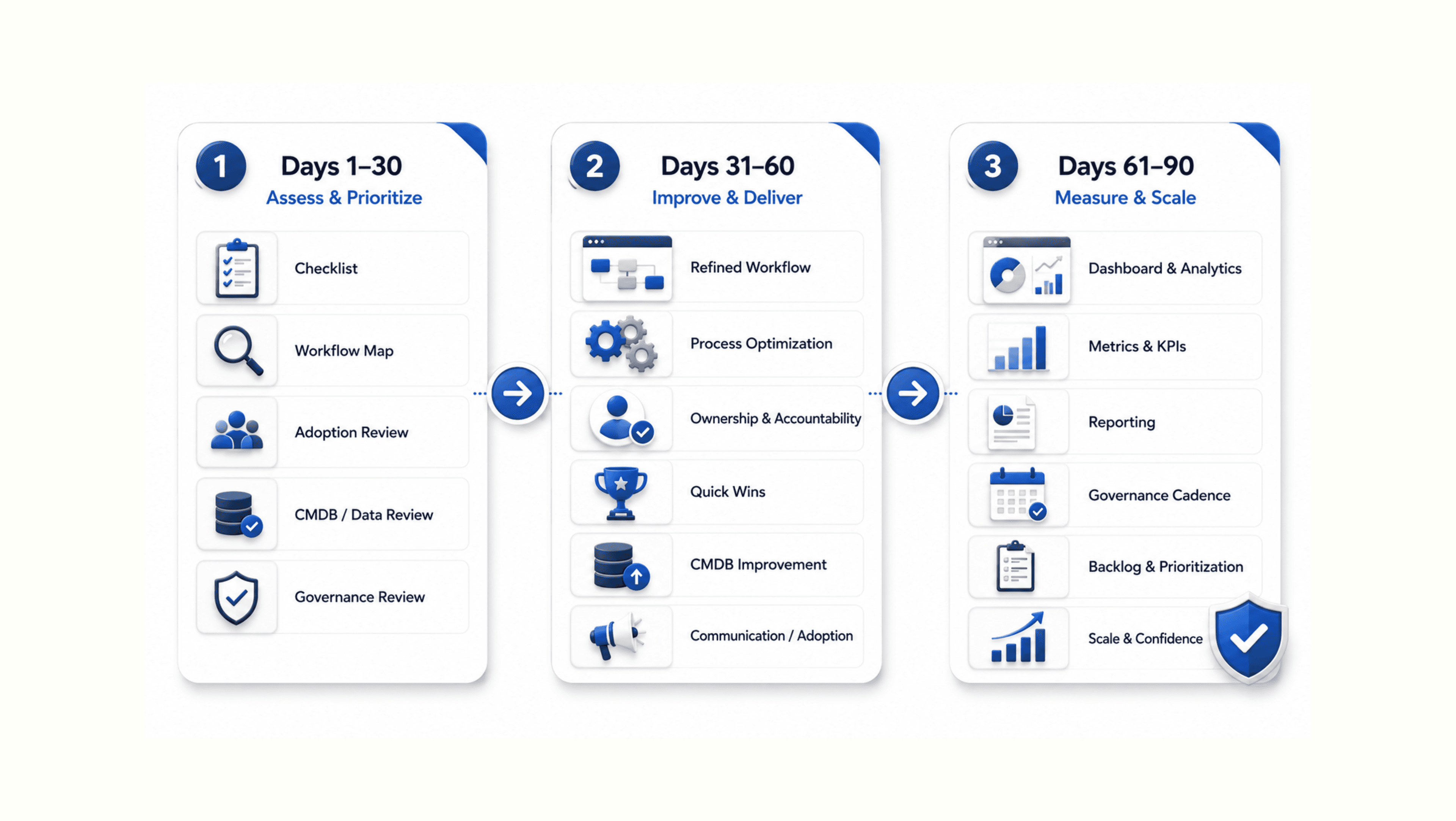
The Year-1 Timeline Nobody Manages

Most teams run a project plan. They don’t run a stabilization plan. That’s why the drop happens mid-year.

Year-1 Stabilization Timeline what to watch + what to do
Phase What Usually Happens What You Must Do Failure Signal
Day 0–30 Go-live optimism. Teams route tickets. Leadership stops paying attention. Lock resolver group ownership, fix categorization rules, train “correct logging” behavior. Bounce starts rising
30–90 Workarounds begin. Shadow escalations rise quietly. Set weekly operational reviews: bounce rate, reopen rate, shadow escalations. WhatsApp escalations persistent
90–180 Automation pressure increases. CMDB gets blamed. Make CMDB “useful”: incident-to-CI linkage trend + ownership hygiene. CI linkage flat near zero
180–365 Adoption decays if trust doesn’t improve. Dashboards still look fine. Only scale automation after the metrics improve for 8–12 consecutive weeks. Outcomes stagnant

Metrics That Actually Predict Year-1 Success (Not Vanity Metrics)

Stop tracking what’s easy to report. Track what reflects behavior and trust.

Year-1 ITSM Health Scorecard (behavior + trust metrics)
Metric What It Measures Healthy Signal Failure Signal
Assignment Bounce Rate Ownership clarity Low + declining High or rising
Reopen Rate Resolution quality Stable or declining Rising
Incident-to-CI Linkage CMDB usefulness Increasing trend Flat near zero
Self-Service Adoption Portal trust Increasing Email dominant
First Contact Resolution Service desk effectiveness Improving Stagnant
Shadow Channel Escalations Trust in ITSM Declining Persistent

If your program isn’t improving these, your implementation is cosmetic.

Visual 2 — Vanity Metrics vs Outcome Metrics what teams track vs what matters

Caption: If you only measure what’s easy, you’ll miss what’s breaking operations. Vanity metrics stay high even when trust collapses.


Automation Readiness Funnel

Visual 3 — Automation Readiness Funnel automation should come last
1) Data Integrity classification, CI hygiene, ownership accuracy 2) Ownership Discipline clear accountability, low bounce rate, stable routing 3) Automation only after outcomes improve week over week

Caption: Automation should come last — not first. If you automate on top of weak data + weak ownership, you scale failure.


What Actually Works (The Stabilization Playbook)

Successful Year-1 programs do fewer things — better:

  • Lock ownership before automation
  • Fix routing before scaling
  • Measure behavior, not configuration
  • Treat CMDB as an operating system, not a database
  • Gate automation behind 8–12 weeks of improving outcomes

A Simple Gate to Prevent Year-1 Failure

Do not scale automation until these are true:

  • Assignment bounce rate trending down for 8 consecutive weeks
  • Reopen rate stable or declining
  • Incident-to-CI linkage shows a visible upward trend
  • Shadow escalations declining month over month

Final Thought

ServiceNow ITSM doesn’t fail because the platform is weak.

It fails because organizations rush to automate before they’re ready to operate.

If you treat ITSM as a tool, you’ll get tickets. If you treat it as an operating model, you’ll get outcomes.

Want to Avoid Becoming Part of the 70%?

Start by fixing ownership and behavior — before adding more workflows. If you want a stabilization plan, we’ll map your Year-1 health scorecard and identify the first 3 fixes that actually move outcomes.


FAQs

1. Is 70% failure a proven statistic?

It reflects consistent enterprise audit and recovery patterns, not vendor marketing claims. Failure here means stalling, regression, or loss of trust — not system shutdown.

2. How long should stabilization take?

Typically 6–9 months after go-live before scaling automation aggressively.

3. Should automation be delayed entirely?

No. It should be gated behind data quality and ownership readiness.

4. Is CMDB mandatory for ITSM success?

Not at Day 1 — but it becomes critical as you scale incident, change, and automation.

5. What’s the earliest warning sign of failure?

Rising assignment bounce rate and persistent shadow-channel escalations within the first 90 days.